Metamemetics
The new philosophy of memetics. Originally published in Critical Meme Reader III.
Tag
Articles tagged memetics.
The new philosophy of memetics. Originally published in Critical Meme Reader III.
Who owns the memes? How dare we ask such a laughable question?
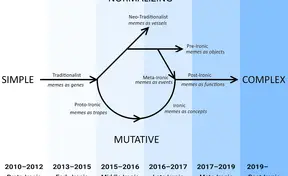
The importance of the 2010's to meme history was not in its novelty but its scale. During the 2010's, the world reached a cultural boiling point as the underground spilled out irreversibly into the mainstream and destroyed the boundaries between the two.
All memes are from the future: the literate memer anticipates that the meme will spread and change in meaning depending on where it gets reposted.
Like a panel in a highly networked version of the Infinite Canvas, every meme is both a potential bottleneck and a possible choice. Since the sense that every meme has a preceding meme is essential to the appreciation of memes, the memetic bottleneck works in the inverse direction of the narrative bottleneck, generating potential pasts. To choose a meme to post is to choose which game to play with the audience. More significantly, it is to choose which save file to load up: it's scenario editing of history, conditioned on current mood.
Seong's thesis on the memeticist's challenge (2018). Supervised by Diane Proudfoot and Douglas Campbell, and completed at the University of Canterbury.
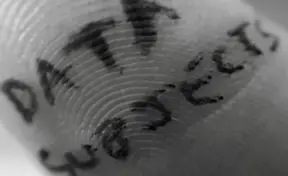
Sites of content production in Web 2.0 are strategic assets which make up the terrain of political conflict in hyperspace.
Seong's thesis on Internet memetics (2016). Supervised by James Maclaurin and Greg Dawes, and completed at the University of Otago.
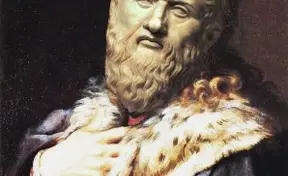
I was walking home from a friend's place yesterday when I saw a few children chasing each other and play fighting. As I walked past, I heard one tell the other, 'get wrecked!' I wondered whether they learned it from video games they play (my guess was either LoL or DotA, but it could be one of those FPSs) or from older kids (or perhaps, most befittingly, even older kids online!) they know such as their older siblings.
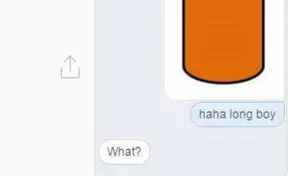
Where have all the Long Boys gone? (Plus an exclusive interview with Special Meme Fresh)
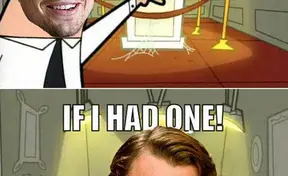
If you have an Internet connection, then you must have noticed how Leonardo DiCaprio’s face and name have infected your computer like some celebratory virus. Everyone is talking about Leo.
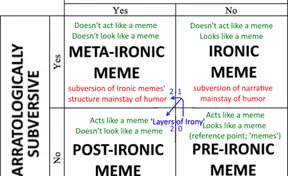
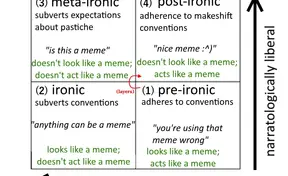
Revised model of the four quadrants model of irony.
A working glossary for ironic meme theory, from normies and autists to meta-irony, normification, and the phylomemetic tree.
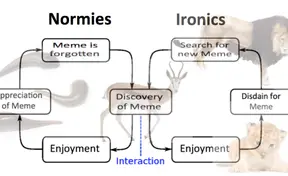
On some parts of the Internet the term ‘normie’ is used to define anyone who does not fully comprehend the humour and language of certain communities. A normie is usually seen as someone who has a social life outside of the Internet, and who does not know, or care, about its obscure customs. In this particular case, the term is as much an accusation as a label, expressing disdain toward anyone who is unaware of the growing community of Ironic memes.
I have been developing a theory of Internet Memes, through which I hope to operationalize memetics for the scientific analysis of Internet Meme culture. Here is a case study I used to test and develop some of my models.
Memes are not just art they are art-concepts, necessarily materialized cybernetically. This means their analysis must always be two-tiered, firstly, memetic; secondly, aesthetic.