Author
Seong-Young Her
44 articles
Articles by Seong-Young Her
-
Metamemetics
The new philosophy of memetics. Originally published in Critical Meme Reader III.
-
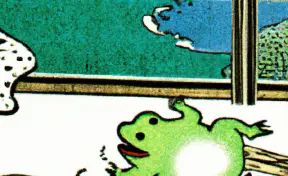
Frog After Frog: Prompt Engineering With Alternate Translations
I report the results of a prompt engineering experiment on DALL-E 2 involving different Japanese-to-English translations of the Frog Haiku by Matsuo Bashō (松尾 芭蕉, 1644 – November 28, 1694).
-
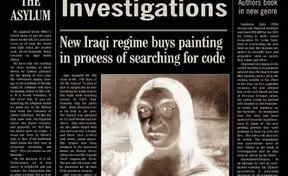
Wittgenstein's Most Beloved Quote Was Real, But It's Fake Now
A serious and good philosophical work could be written consisting entirely of fake philosophy quotes.
-
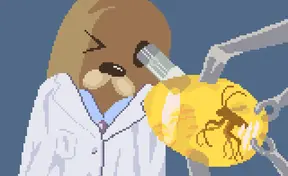
Homesteading the Memeosphere
Who owns the memes? How dare we ask such a laughable question?
-
We Can Have Retrieval-Inference Synthesis
A Modern Synthesis of art criticism is possible.
-
GamerGate As Metagaming
GamerGaters were correct in their assessment of gaming culture and the games industry precisely because of the conspiracy theoretical nature of their campaign.
-
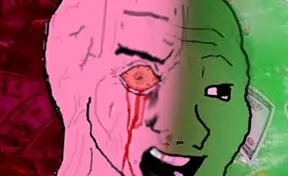
GME Frenzy Hints At the New Stage of Memecultures
A central theme of post-2015 memecultures was the gamification of memes. This gave rise to Facebook memepages as well as a "meme president". Post-2020 memecultures now struggle with the challenge of the cope, which is an inevitable consequence of creating new games with a loss condition.
-
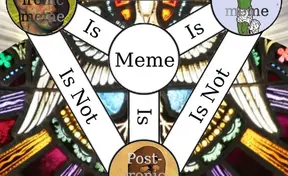
2010's Decade Review, Part 2: Memetaphysics Through Three Lenses
In this article, I explore the new metaphysics of memes that developed throughout the 2010s. I use three distinct perspectives to approach this vast subject matter: time; place; and, process.
-
Postnaturalism
All technology exerts some epistemic influence on the observer, and this is often epistemologically relevant; the proper function of philosophy is to study the epistemic effect of technology, and to design and produce epistemically useful technology; localised agreements rather than shared beliefs, entailed by the use of common technology, are sufficient foundations for philosophical discourse.
-

A Tale of Two Healthcare Narratives
Some conservatives claim that the free market saved Korea from COVID-19. I argue that it was Korea's Confucian democracy and technological environment that helped them contain the pandemic, not the lack of supply side regulation.
-
Jjalbang (짤방), the Korean Meme
Fundamental Concepts In International Meme Studies: Jjalbang, the Korean Meme
-
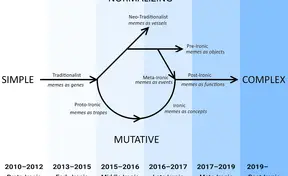
2010's Decade Review, Part 1: The Origin of 2010's Memecultures
The importance of the 2010's to meme history was not in its novelty but its scale. During the 2010's, the world reached a cultural boiling point as the underground spilled out irreversibly into the mainstream and destroyed the boundaries between the two.
-

Every Gondola Is a Shrine
I think of every gondola post as a shrine, for people to come together and appreciate them in a spiritual way.
-
All Memes Are From the Future
All memes are from the future: the literate memer anticipates that the meme will spread and change in meaning depending on where it gets reposted.
-
How to Digitally Coauthor Articles In Philosophy Class
A group assignment activity for philosophy students at the undergraduate level, which can be applied in tandem with existing curricula. Consists of a way to standardise the work of each individual student such that each student’s contributions to the group assignment fits in seamlessly with the other team members’ contributions, and a way to apply the system to the specific course material being assessed.
-

The Memetic Bottleneck
Like a panel in a highly networked version of the Infinite Canvas, every meme is both a potential bottleneck and a possible choice. Since the sense that every meme has a preceding meme is essential to the appreciation of memes, the memetic bottleneck works in the inverse direction of the narrative bottleneck, generating potential pasts. To choose a meme to post is to choose which game to play with the audience. More significantly, it is to choose which save file to load up: it's scenario editing of history, conditioned on current mood.
-
The New Year's Memes
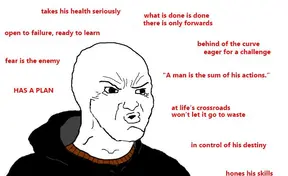
Memes are made by shitposters that live in the meatspace, which makes them affected by human schedules. It's a trivial point, but the schema of memes as semi-independent entities that float around on the sea of the Internet is too popular for this point not to be insightful.
-

The Memeticist's Challenge Remains Open
Seong's thesis on the memeticist's challenge (2018). Supervised by Diane Proudfoot and Douglas Campbell, and completed at the University of Canterbury.
-

Structure and Content in Drake-Style Templates
Two dimensions stand out that make the two templates the same: 1. the structure (aversion/affirmation) 2. the content (rappers in music videos)
-
The design of a platform determines the kind of content produced
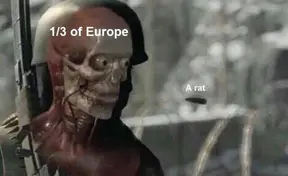
It's a great example of how shaky the definition of 'Internet meme' as 'a funny image or video clip' really is. Are these photos each a meme, or do they compose a single meme through being viewed together?
-

Know Your Meme: Magibon
The notion of authenticity in online celebrities is concurrent with the notion of authenticity in Internet memes (cf. forced memes) mimics the notion of authenticity in fictional characters (cf. fanon).
-
Kandinsky and Loss
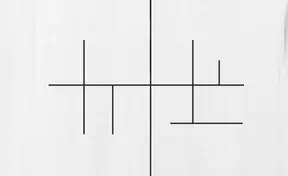
Tracing back techniques used in memes to modern art is a safe bet, because it's only natural that memers will use whatever tools are available to make better memes.
-

Moe to Memes, Otaku to Autists
The archetypal online community is specialised in its collective interests, hostile to outsiders, particular about its tastes and difficult for normies to get into. Knowledge and skill, especially when useful for creating relevant content for the community, is highly valued; "otaku" is the Japanese equivalent of the "autist".
-
![When You Drink [water]](/_astro/23472012_2053909424842673_2720000468904660127_n.BhyeRpjr_Z1uBkH1.webp)
When You Drink [water]
Post-ironic memes are great because they are meaningful. Meaningful memes bring us closer to the dream of the timeless meme, just like early comics artists who aspired towards serious literature with an ostensibly unserious medium.
-
Memes Are Not Jokes, They Are Diagram-Games
The meme means different things to different viewers as a matter of degrees, not a matter of either getting the joke or missing it, or reading it ironically or not.
-
The Meta-Ironic Era
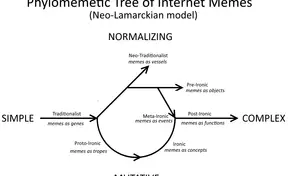
In 2017, at the time of writing, most readers will find it difficult to imagine how different the dynamics of the meme community were in 2014. The sum of every memepage at the time, duplicates or no, was far smaller than a single large memepage active today.
-
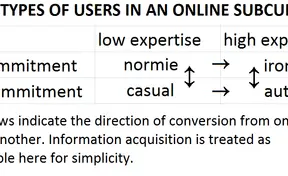
Defining ‘Normie’, ‘Casual’, ‘Ironist’ and ‘Autist’ In Internet Subcultures
The following is my take on doing the same for online subcultures. I do this by clarifying the definitions of three highly popular terms used on the Internet to describe different kinds of subcultural participants, and clarifying the concept of the ironist in the context of online subcultures.
-
A School of Internet Philosophy
I think there's a school of ‘Internet philosophy’ like there is continental philosophy or Anglo-American philosophy, with its own dominant interests and a unique style of discourse. I'm trying to figure out what this consists of. It's a combination of demographics, dominant areas of interest (both within and without strict philosophy) and conventions and canons unique to the school.
-
Facebook Groups
This article focuses on the ironic meme community and the geography of Facebook memepages.
-
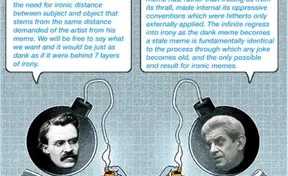
Post-Irony against Meta-Irony
The Ironic Meme Movement was a reaction against the mainstream co-option of the subcultural products of the underground; an attempt to create incorruptible inside jokes. The Ironics employed defensive strategies which paralleled that of the punks against the commercialization of their own subculture. Like the punks, they failed.
-

Trash Dove Is A Normie Meme
Normies are users with low memetic literacy or fluency. Trash Dove is a normie meme. That might very well change in the future.
-
Internet Memetics
Seong's thesis on Internet memetics (2016). Supervised by James Maclaurin and Greg Dawes, and completed at the University of Otago.
-
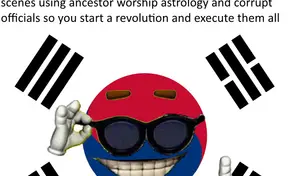
President Park's Corruption Cult
On Park Geun-Hye, Choi Soon-Sil, Ilbe, meme magic, and the rage of watching Korean democracy dragged through another cult of power.
-
An Internet Koan
I just found a really strange website where a guy claims Zen is a scam and that he's figured out how to solve any koan. He even provides a Free Zen Riddle and Koan Service through which you can email him a koan and receive an answer.
-
Newfriends and the Generation Gap
I was walking home from a friend's place yesterday when I saw a few children chasing each other and play fighting. As I walked past, I heard one tell the other, 'get wrecked!' I wondered whether they learned it from video games they play (my guess was either LoL or DotA, but it could be one of those FPSs) or from older kids (or perhaps, most befittingly, even older kids online!) they know such as their older siblings.
-
-
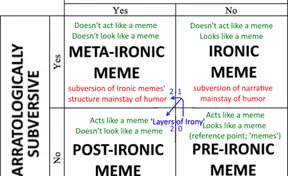
The Revised Quadrant Model
Revised model of the four quadrants model of irony.
-

A Short Note On Gondola
There's a new meme becoming popular in the Anglosphere called Gondola. It's a derivative of Spurdo Sparde with no arms or dialogue, generally walking around in various scenes from classic artworks to everyday life. I think they could be most easily characterized in opposition to Pepe or Spurdo, both of whom are subversive in the classically Ironic Meme style of inappropriateness. Pepe will murder Wojak over and over while Spurdo will spout every satirizable position in misspelled and poorly drawn way possible. As usual, everyone's worry is about how normies will ruin Gondola. Not if or when; it's taken for granted that Gondola will become corrupted.
-
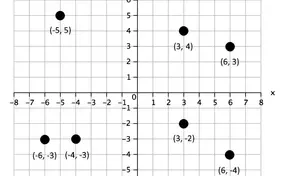
Bane, Loss and Phylogeny
I have been developing a theory of Internet Memes, through which I hope to operationalize memetics for the scientific analysis of Internet Meme culture. Here is a case study I used to test and develop some of my models.
-
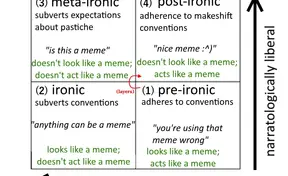
The Quadrant System for the Categorization of Internet Memes
Memes are not just art they are art-concepts, necessarily materialized cybernetically. This means their analysis must always be two-tiered, firstly, memetic; secondly, aesthetic.
-
A Golden Age of Meme Pages and the Microcosm of Art History
How Facebook meme pages briefly became a new artistic medium, pushing ironic memes from curation and shitposting toward meta-irony.
-
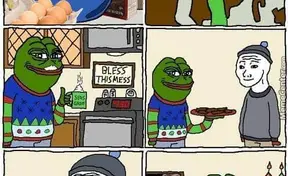
A Short Note On the Death of Pepe
Honestly, I miss this meme. I guarantee that Pepe the Frog is going to become the biggest 'normie' meme of all time. It's popular with high school kids, who are basically the equivalent of university activists in the world of internet culture.
-
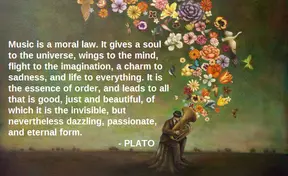
Misattributed Plato Quote Is Real Now
It seems to me that 'quotes' such as these which become canon in the public psyche take on a special kind of force that highlights the close relationship between truth and beauty, as well as the fact that the two are not one and the same--although (I hope you will agree) truth is often beautiful, and there is always some truth in beauty.
-
The Artist-Philosopher Manifesto
We, the artists of the future, refuse to be the plaything of politics.