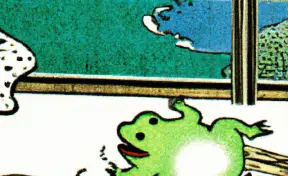
I report the results of a prompt engineering experiment on DALL-E 2 involving different Japanese-to-English translations of the Frog Haiku by Matsuo Bashō (松尾 芭蕉, 1644 – November 28, 1694).
Tracing back techniques used in memes to modern art is a safe bet, because it's only natural that memers will use whatever tools are available to make better memes.
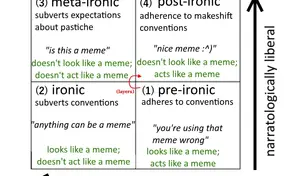
There's a new meme becoming popular in the Anglosphere called Gondola. It's a derivative of Spurdo Sparde with no arms or dialogue, generally walking around in various scenes from classic artworks to everyday life. I think they could be most easily characterized in opposition to Pepe or Spurdo, both of whom are subversive in the classically Ironic Meme style of inappropriateness. Pepe will murder Wojak over and over while Spurdo will spout every satirizable position in misspelled and poorly drawn way possible. As usual, everyone's worry is about how normies will ruin Gondola. Not if or when; it's taken for granted that Gondola will become corrupted.
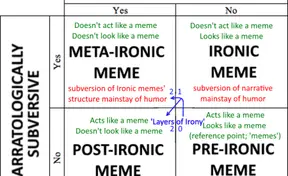
I have been developing a theory of Internet Memes, through which I hope to operationalize memetics for the scientific analysis of Internet Meme culture. Here is a case study I used to test and develop some of my models.
Memes are not just art they are art-concepts, necessarily materialized cybernetically. This means their analysis must always be two-tiered, firstly, memetic; secondly, aesthetic.
Honestly, I miss this meme. I guarantee that Pepe the Frog is going to become the biggest 'normie' meme of all time. It's popular with high school kids, who are basically the equivalent of university activists in the world of internet culture.